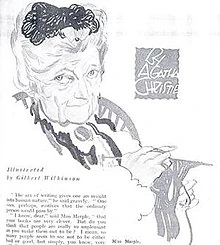
Miss Marple lives in the village of St. Mary Mead and acts as an amateur consulting detective. Often characterized as an elderly spinster.
She solves difficult crimes thanks to her shrewd intelligence, and St. Mary Mead, over her lifetime, has given her seemingly infinite examples of the negative side of human nature. Crimes always remind her of a previous incident, although acquaintances may be bored by analogies that often lead her to a deeper realization about the true nature of a crime. She also has a remarkable ability to latch onto a casual comment and connect it to the case at hand.
Miss Marple never married and has no close living relatives. Her nephew, the "well-known author" Raymond West, appears in some stories. Raymond overestimates himself and underestimates his aunt's mental acuity.
In her first published story, a group of friends are meeting at the house of Miss Marple in St Mary Mead. As well as the old lady herself, there is her nephew – the writer Raymond West – the artist Joyce Lemprière, Sir Henry Clithering (a former Scotland Yard commissioner), a clergyman called Dr.Pender, and Mr. Petherick, a solicitor. The conversation turns to unsolved mysteries; Raymond, Joyce, Pender, and Petherick all claim that their professions are ideal for solving crimes. Joyce suggests that they form a club; every Tuesday night, a member of the group must tell of a real mystery, and the others will attempt to solve it. Sir Henry agrees to participate, and Miss Marple brightly volunteers herself to round out the group.
Sir Henry tells the first story of three people who sat down to a supper after which all of them fell ill, supposedly of food poisoning, and one died as a result. The three people were a Mr. and Mrs. Jones and the wife's companion, Miss Clark, and it was Mrs. Jones who died. Mr. Jones was a commercial traveler; a maid in one of the hotels in which he stayed saw blotting paper he had used to write a letter, whose decipherable phrases referred to his dependency on his wife's money, her death, and "hundreds and thousands". The maid read of the death in a paper and, knowing relatives in the same village where Mr. and Mrs. Jones lived, wrote to them. This started a chain of gossip which led to the exhumation of the body and the discovery that Mrs. Jones was poisoned with arsenic. There was further gossip linking Mr. Jones to the doctor's daughter, but there was nothing substantive there. The Jones's maid, Gladys, tearfully confirmed that all three people had been served the same meal of tinned lobster, bread and cheese, and trifle. She had also prepared a bowl of cornflour for Mrs. Jones to calm her stomach, but Miss Clark ate this, despite the diet she was on for her consistent weight problems. Jones also had a plausible explanation for the letter which was blotted in the hotel room.
The people in the room deliver their various theories as to who the murderer is, but neglect to ask Miss Marple, until Sir Henry politely points out the omission. Miss Marple witters on about a similar case involving a local family (to which Raymond cannot see any relevance) until she suddenly asks Sir Henry if Gladys confessed, and says that she hopes Mr. Jones will hang for what he made the poor girl do. The letter in the hotel room was to Gladys. Hundreds and thousands refers to sweets sprinkled atop the dessert; Mr. Jones had mixed arsenic with them and given them to Gladys to use for the trifle. Miss Clark had not eaten the dessert (due to her diet) and Mr. Jones scraped off the poisoned sweets. Sir Henry confirms that Miss Marple is correct. Mr. Jones had got Gladys pregnant and used a promise of marriage after his wife's death to persuade the girl to commit murder. He then married someone else. The baby died shortly after its birth and Gladys confessed while dying.
All published appearances of Miss Marple from before January 1, )-(95)}} are public domain in the US.
Some notable appearances are listed below:
* The Tuesday Night Club (December 1927)
* The Idol House of Astarte (January 1928)
* Ingots of Gold (February 1928)
* The Blood-Stained Pavement (March 1928)
* Motive versus Opportunity (April 1928)
* The Thumb Mark of St. Peter (May 1928)
* The Blue Geranium (December 1929)
* The Murder at the Vicarage (1930, Novel)
* The Hat and the Alibi (1930)
* The Resurrection of Amy Durrant (1930)
* The Herb of Death (1930)
* The Four Suspects (1930)
* The Affair at the Bungalow (1930)
*[https://en.wikipedia.org/wiki/Miss_Marple Wikipedia]
*[https://agathachristie.fandom.com/wiki/Jane_Marple Agatha Christie Wiki]
*[https://comicvine.gamespot.com/miss-marple/4005-87873/ ComicVine]
*[https://fictional-characters-in-media.fandom.com/wiki/Miss_Marple Fictional Characters in Media Wiki]
Category:Literary Characters
Category:Detective Characters
Category:Female Characters
Category:Elderly Characters
Category:1927 Debuts
Category:Agatha Christie - Creator
Category:Movie Characters
Category:Theatre Characters
Category:Radio Characters
Category:Television Characters
Category:Comic Book Characters
Category:Manga / Anime Characters
Category:Teenage Mutant Ninja Turtles Characters
Category:Aeon Crash Characters

Miss Marple
-
Debut
The Tuesday Night Club (The Royal Magazine - December 1927)
Miss Marple lives in the village of St. Mary Mead and acts as an amateur consulting detective. Often characterized as an elderly spinster.
She solves difficult crimes thanks to her shrewd intelligence, and St. Mary Mead, over her lifetime, has given her seemingly infinite examples of the negative side of human nature. Crimes always remind her of a previous incident, although acquaintances may be bored by analogies that often lead her to a deeper realization about the true nature of a crime. She also has a remarkable ability to latch onto a casual comment and connect it to the case at hand.
-
Real Name
Jane Marple
-
Original Publisher
C. Arthur Pearson Ltd
-
Created By
Agatha Christie
All data from the awesome folks at Marvel.