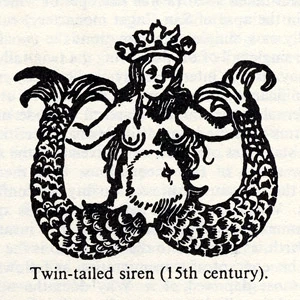
Melusine is a figure of European folklore, a female spirit of fresh water in a holy well or river. She is usually depicted as a woman who is a serpent or fish from the waist down (much like a lamia or a mermaid). She is also sometimes illustrated with wings, two tails, or both. Her legends are especially connected with the northern and western areas of France, Luxembourg, and the Low Countries.
The Limburg-Luxemburg dynasty (which ruled the Holy Roman Empire from 1308 to 1437 as well as Bohemia and Hungary), the House of Anjou and their descendants the House of Plantagenet (kings of England), and the French House of Lusignan (kings of Cyprus from 1205–1472, and for shorter periods over Cilician Armenia and Jerusalem) are said in folk tales and medieval literature to be descended from Melusine. The story combines several major legendary themes, such as the Nereids, Naiad, water nymph or mermaid, the earth being (terroir), the genius loci or guardian spirit of a location, the succubus who comes from the diabolical world to unite carnally with a man, or the banshee or harbinger of death.
The most famous literary version of Melusine tales, that of Jean d'Arras, compiled about 1382–1394, was worked into a collection of "spinning yarns" as told by ladies at their spinning coudrette. He wrote The Romans of Partenay or of Lusignen: Otherwise known as the Tale of Melusine, giving source and historical notes, dates and background of the story. He goes into detail and depth about the relationship of Melusine and Raymondin, their initial meeting, and the complete story.
The tale was translated into German in 1456 by Thüring von Ringoltingen, which version became popular as a chapbook. It was later translated into English, twice, around 1500, and often printed in both the 15th century and the 16th century. There are also a Castilian and a Dutch translation, both of which were printed at the end of the 15th century.[4] A prose version is entitled the Chronique de la princesse (Chronicle of the Princess).
The story tells how in the time of the Crusades, Elinas, the King of Albany (an old name for Scotland or the Kingdom of Alba), goes out hunting in the forest to cope with the death of his wife with whom he has one son named Nathas. Elinas comes across the Well of Thirst where he meets a beautiful fay named Pressine. The two fall in love and when Elinas proposes to Pressine, she agrees, but only if he swears to never see her when she births or bathes their children; Elinas promises and he and Pressine marry. Later, Pressine gives birth to triplet girls named Melusine, Melior, and Palatine. When Nathas informs his father the news, he breaks his promise, causing Pressine to leave the kingdom with their three daughters and move to the lost Isle of Avalon.
The three sisters grow up in Avalon, their mother bringing them atop a mountain every morning to look at the kingdom that would have been their home. On their fifteenth birthday, Melusine, the eldest, asks her mother why she and her sisters had been taken from Alba. Upon hearing of their father's broken promise, Melusine seeks revenge and convinces her sisters to aid her. Using their magical powers, Elinas' daughters lock him, with his riches, in a mountain called Brandelois. Pressine becomes enraged when she learns what her daughters have done for despite breaking his promise, Elinas was her husband and the triplets' father. To punish her daughters for killing their own father, Pressine imprisons Palatine in the same mountain as Elinas, seals Melior inside a castle for all her life, and banishes Melusine, the instigator, from Avalon and also cursing her to take the form of a two-tailed serpent from the waist down every Saturday. If a man ever marries Melusine, he must never see her on Saturdays: if he keeps the oath, Melusine will live a contented life with him, but if he breaks it and violates her privacy, she will stay a serpent and appear to the Noble House in her monstrous form and spend three days lamenting whenever a descendant dies or the fortress changes hands.
Melusine settles in a forest of Coulombiers by a stream near Poitiers (or Poitou in some versions) in France. The distraught Count Raymondin of Poitiers comes across Melusine after accidentally killing his uncle. Melusine consoles Raymondin and when he proposes to her, she lays down a condition just as her mother had done: that he must never see her on a Saturday. For ten years Raymondin keeps his promise, and Melusine bears him ten sons (which some versions describe as being deformed yet still loved by their parents) and organizes the construction of marvelous castles, giving her husband wealth, land, and power. However, Raymondin is eventually goaded by his family and grows suspicious of Melusine always spending Saturday by herself and never attending Mass. He breaks his promise and peeks into her chamber, where he sees Melusine bathing in half-serpent form. He keeps his transgression a secret, until one of their now-adult sons murders his brother. In front of his court, the grieving Raymondin blames Melusine and calls her a "serpent." She then assumes the form of a dragon, provides him with two magic rings, and flies off, never to be seen again. She returns only at night to nurse her two youngest children, who are still infants.
All published appearances of Melusine from before January 1, )-(95)}} are public domain in the US.
* The Legend of Melusine a.k.a. The History of Lusignan, by Jean d’Arras (1393) – translation to late Middle English (ca. 1500)
* The Romance of Melusine a.k.a. The Romance of Parthenay, by Coudrette (1400s) – translation to late Middle English (ca. 1500)
* The New Melusine, by Johann Wolfgang von Goethe (1821) – story in Wilhelm Meister’s Journeyman Years
* The Fairy Mythology, by Thomas Keightley (1828)
* “The Fairy of the Fountains,” by Letitia Elizabeth Landon (1834) – poem in Fisher’s Drawing Room Scrap Book
* An Explanatory and Pronouncing Dictionary of the Noted Names of Fiction, by William A. Wheeler (1865)
* Curious Myths of the Middle Ages, by S. Baring‐Gould (1868)
* Dictionary of Phrase and Fable, by E. Cobham Brewer (1870)
* “Melusine,” by Francis Turner Palgrave (1871) – poem in Lyrical Poems
* “Snake Women” (6 Feb. 1875) – article in All the Year Round
* Romances of Chivalry Told and Illustrated in Fac‐simile, by John Ashton (1887)
* History of Prose Fiction, by John Colin Dunlop (new ed., 1888)
* The Book of Legends Told Over Again, by Horace E. Scudder (1899)
* Melusine, by George Ernle (1908)
* The Encyclopædia Britannica (11th ed., 1911)
* Stories from Mediaeval Romance, by Netta Syrett (1913)
* Heroes and Heroines of Fiction, by William S. Walsh (1915)
* The Land of Haunted Castles, by Robert J. Casey (1921)
* The High Place, by James Branch Cabell (1923)
* Melusina (singspiel), libretto by Franz Grillparzer, music by Conradin Kreutzer (1833)
* La magicienne (opera), libretto by Jules‐Henri Vernoy de Saint‐Georges, music by Fromental Halévy (1858)
* Babil and Bijou, or The Lost Regalia, libretto by Dion Boucicault and J. R. Planché, music by G. Jacobi (1872)
* Melusine (opera), by Carl Grammann (1875)
*The siren or mermaid with two tails and a crown, a heraldic symbol which inspired the Starbucks logo, is frequently identified as a melusine.
*In Fate/Grand Order, Mélusine is a playable character who also goes by the name of Tam Lin Lancelot. Her true identity is revealed to be the remains of the dragon Albion in the story.
*[https://en.wikipedia.org/wiki/Melusine# Wikipedia]
*[https://comicvine.gamespot.com/melusine/4005-156474/ ComicVine]
*[https://myths-in-media.fandom.com/wiki/Melusine Myths in Media Wiki]
*MarvelWiki
*Mythological Creatures Wiki
*Dragons Wiki
*Mermaid Wiki
*Military Wiki
Category:Female Characters
Category:Literary Characters
Category:Aquatic Characters
Category:Folklore Characters
Category:Reptile Themed Characters
Category:Mermaid Characters
Category:Winged Characters
Category:European Characters
Category:Manga / Anime Characters
Category:Advertising Characters
Category:Fate Franchise Characters
Category:Age of Ishtaria Characters
Category:TCG Characters
Category:Blood Brothers Characters
Category:Ever Legion Characters
Category:Final Fantasy Characters
Category:Genshin Impact Characters
Category:Kamihime Project Characters
Category:Shin Megami Tensei Characters
Category:Monster Musume Characters
Category:Tokyo Afterschool Summoners Characters
Category:Dargaud Characters
Category:Dark Horse Characters
Category:Comic Book Characters
Category:Unknown Creator
Category:Unknown Debuts
Category:Television Characters
Category:Movie Characters
Category:Dragon Characters
Category:Meme Characters
Category:Robot Chicken Characters
Category:Destiny of Spirits Characters
Category:Deity Wars Characters
Category:Ravenswatch Characters
Category:Dreamworks Characters
Category:Streaming Television Characters
Category:Food Mascots
Category:Legend of Minerva Characters
Category:NBC Characters
Category:Macy's Parade Characters
Category:Play Presse Characters
Category:Extra Credits Characters
Category:Witcher Characters
Category:Mitos y Leyendas Characters
Category:Reverse 1999 Characters
Category:Aigis Characters

Melusine
-
Debut
European folklore
Melusine is a figure of European folklore, a female spirit of fresh water in a holy well or river. She is usually depicted as a woman who is a serpent or fish from the waist down (much like a lamia or a mermaid). She is also sometimes illustrated with wings, two tails, or both. Her legends are especially connected with the northern and western areas of France, Luxembourg, and the Low Countries.
-
Created By
Unknown
All data from the awesome folks at Marvel.